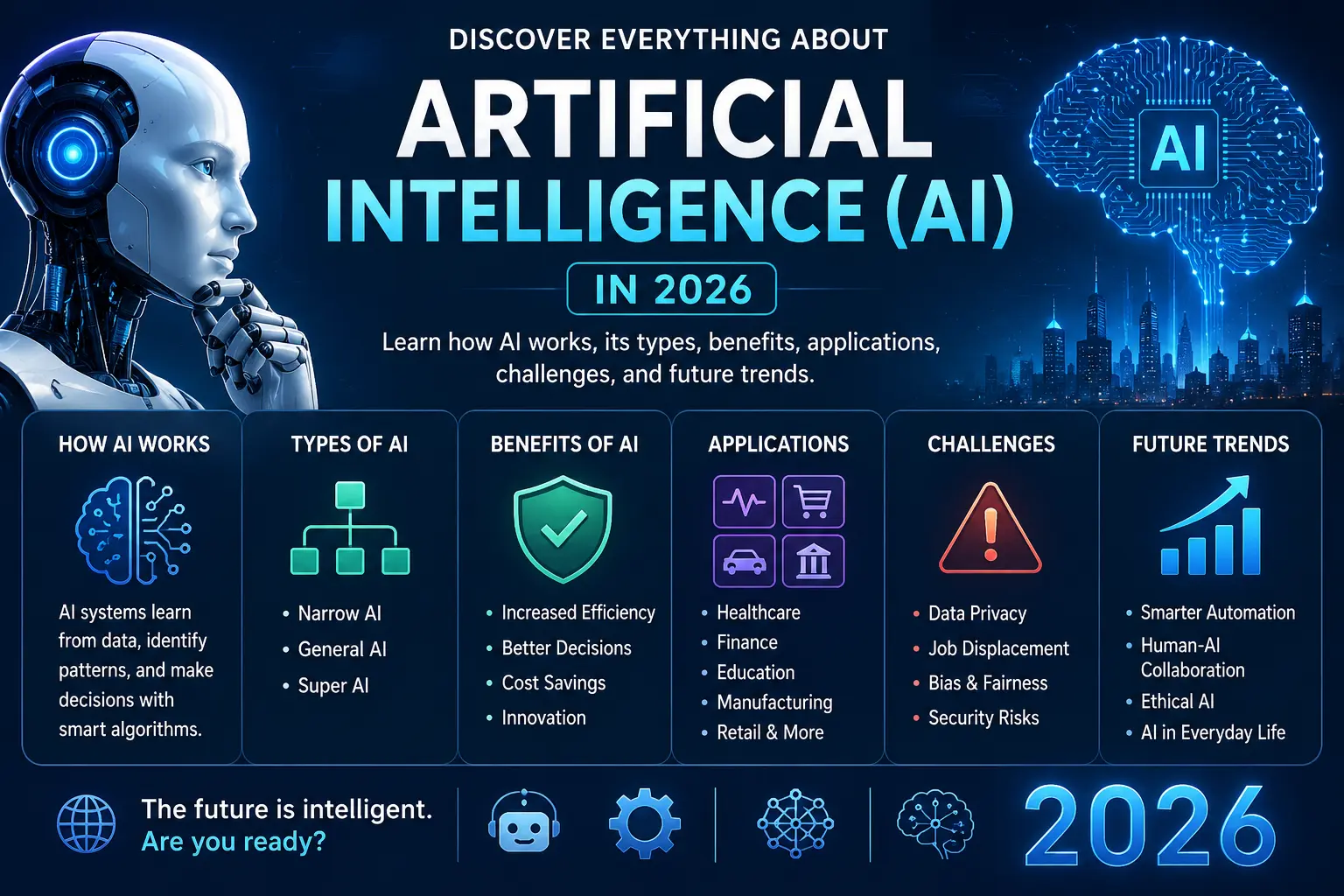
Artificial Intelligence (AI) in 2026 is transforming the world at an unprecedented pace. From voice assistants and self-driving cars to healthcare, ed
ucation, finance, and business automation, AI has become one of the most influential technologies of the modern era. In 2026, AI is no longer just a futuristic concept—it is a core part of daily life and business operations.
This comprehensive guide explains what Artificial Intelligence is, how it works, its different types, benefits, real-world applications, challenges, and what the future holds.
What Is Artificial Intelligence (AI)?
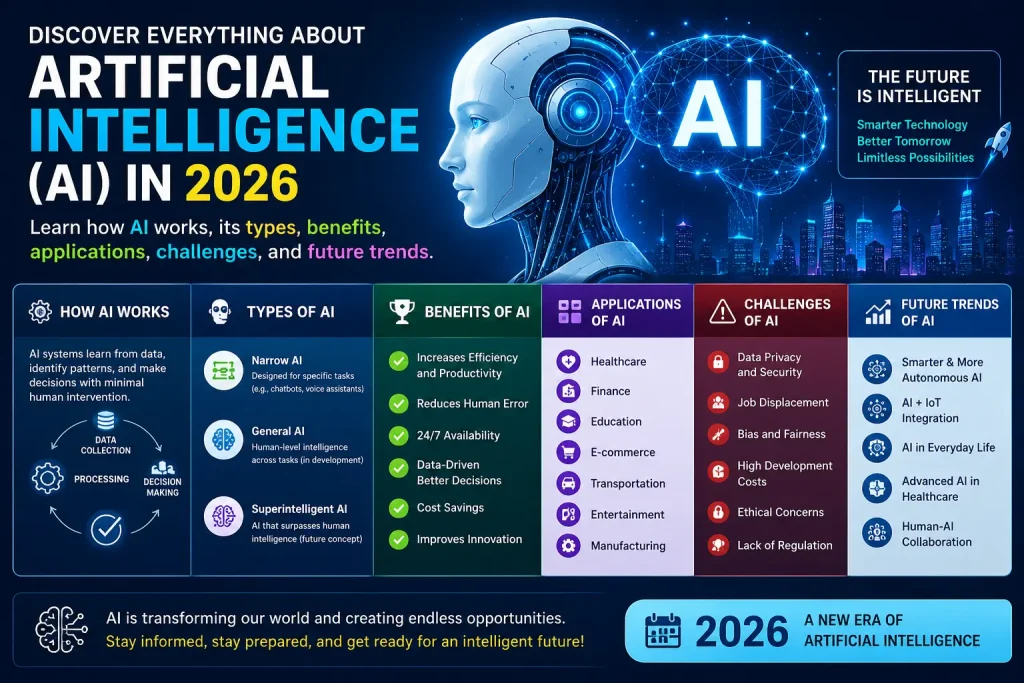
Artificial Intelligence (AI) is a branch of computer science that enables machines to simulate human intelligence. AI systems can learn from data, recognize patterns, solve problems, make decisions, and improve over time with minimal human intervention.
Unlike traditional software, AI adapts and becomes more effective as it processes additional information.
Examples of AI in Everyday Life
- Voice assistants like Siri, Alexa, and Google Assistant
- Chatbots for customer support
- AI-powered search engines
- Netflix and YouTube recommendations
- Spam email filters
- Online shopping recommendations
- Face recognition on smartphones
- AI writing assistants
Artificial Intelligence (AI) in 2026: How Does Artificial Intelligence Work?
Artificial Intelligence works by combining several technologies:
Machine Learning (ML)
Machine Learning allows computers to learn from data without being explicitly programmed.
Example
A spam detection system learns which emails are spam by analyzing thousands of previous emails.
Deep Learning
Deep Learning uses neural networks inspired by the human brain to process massive amounts of information.
Deep learning powers:
- Image recognition
- Speech recognition
- Medical diagnosis
- Self-driving vehicles
Natural Language Processing (NLP)
NLP helps computers understand, interpret, and generate human language.
Examples include:
- ChatGPT
- AI chatbots
- Google Translate
- Voice assistants
Computer Vision
Computer Vision enables machines to analyze and understand images and videos.
Applications include:
- Facial recognition
- Medical imaging
- Security surveillance
- Autonomous vehicles
Types of Artificial Intelligence (AI) in 2026
1. Narrow AI (Weak AI)
Designed for specific tasks.
Examples:
- Recommendation systems
- Chatbots
- Image recognition
- Voice assistants
2. General AI
General AI aims to perform any intellectual task that a human can do.
Currently, this remains a research goal.
3. Super AI
A theoretical form of AI that would surpass human intelligence across virtually all domains.
Super AI does not exist today.
Benefits of Artificial Intelligence (AI) in 2026
AI provides significant advantages across industries.
Increased Productivity
AI automates repetitive tasks, allowing people to focus on higher-value work.
Improved Accuracy
AI reduces human errors in data analysis, diagnostics, and decision-making.
Better Customer Experience
Businesses use AI chatbots and recommendation engines to deliver personalized experiences.
Faster Decision Making
AI processes enormous datasets in seconds, helping organizations make informed decisions.
Cost Reduction
Automation lowers operational costs and increases efficiency.
Real-World Applications of Artificial Intelligence (AI) in 2026
Healthcare
- Disease diagnosis
- Medical imaging analysis
- Drug discovery
- Virtual healthcare assistants
Education
- Personalized learning
- Automated grading
- AI tutors
- Smart classrooms
Finance
- Fraud detection
- Credit scoring
- Investment analysis
- Customer support
Retail
- Product recommendations
- Inventory management
- Customer behavior analysis
- Dynamic pricing
Manufacturing
- Predictive maintenance
- Quality inspection
- Robotics
- Supply chain optimization
Transportation
- Autonomous vehicles
- Traffic prediction
- Route optimization
- Fleet management
Marketing
Businesses use AI for:
- SEO optimization
- Content creation
- Email marketing
- Social media automation
- Customer segmentation
- Advertising optimization
Artificial Intelligence in Business
AI has become an essential competitive advantage.
Businesses use AI to:
- Analyze customer data
- Improve sales forecasting
- Automate customer service
- Generate reports
- Optimize pricing
- Detect fraud
- Improve cybersecurity
Small businesses also benefit from affordable AI tools for content creation, scheduling, analytics, and customer engagement.
Challenges of Artificial Intelligence (AI) in 2026
Despite its benefits, AI presents several challenges.
Privacy Concerns
AI systems often rely on large datasets, raising concerns about personal data protection.
Bias
Poor-quality or unrepresentative training data can produce unfair outcomes.
Job Displacement
Automation may replace certain repetitive roles while creating demand for new skills.
Security Risks
AI can be misused for cyberattacks, misinformation, or sophisticated fraud.
Ethical Issues
Responsible AI development requires transparency, accountability, and human oversight.
Future of Artificial Intelligence
The future of AI is expected to include:
- More advanced AI assistants
- Smarter healthcare systems
- Autonomous transportation
- AI-powered scientific research
- Personalized education
- Enhanced cybersecurity
- Sustainable energy optimization
- Human-AI collaboration across industries
As AI continues to evolve, organizations that adopt it responsibly are likely to gain a significant competitive advantage.
Tips for Learning Artificial Intelligence
If you’re new to AI:
- Learn Python programming.
- Understand basic mathematics and statistics.
- Study machine learning concepts.
- Explore deep learning frameworks.
- Build small AI projects.
- Practice with real-world datasets.
- Stay updated on emerging AI trends.
Frequently Asked Questions (FAQs)
What is Artificial Intelligence?
Artificial Intelligence is the simulation of human intelligence in machines that can learn, reason, and make decisions.
Is AI replacing human jobs?
AI automates some tasks, but it also creates new roles in AI development, data science, cybersecurity, and technology management.
What programming language is best for AI?
Python is the most popular language for AI because of its extensive ecosystem and ease of use.
Is Artificial Intelligence (AI) in 2026 safe?
AI can be highly beneficial when developed and used responsibly with appropriate safeguards, transparency, and oversight.
Can beginners learn Artificial Intelligence (AI) in 2026?
Yes. Many free and paid learning resources make AI accessible to beginners with no prior experience.
Conclusion
Artificial Intelligence is reshaping industries, businesses, and everyday life in 2026. Whether you’re a student, professional, entrepreneur, or technology enthusiast, understanding AI is becoming an essential skill.
By learning how AI works, exploring its practical applications, recognizing its challenges, and staying informed about new developments, you can make better decisions and prepare for the future. As AI continues to advance, those who embrace lifelong learning and responsible innovation will be best positioned to thrive.
- Introduction to Artificial Intelligence (AI)
- What Is Artificial Intelligence?
- A Brief History of AI
- How Does Artificial Intelligence Work?
- Types of Artificial Intelligence
- Machine Learning vs. Deep Learning vs. AI
- Key Technologies Behind AI
- Benefits of Artificial Intelligence
- Real-World Applications of AI
- AI in Everyday Life
- AI Tools You Should Know in 2026
- Challenges and Risks of AI
- Ethical Concerns in Artificial Intelligence
- The Future of AI: Trends for 2026 and Beyond
- AI Career Opportunities and Required Skills
- How to Start Learning Artificial Intelligence
- Common Myths About AI
- Frequently Asked Questions (FAQs)
- Conclusion
Please let me know if you have any complaints about this content. Contact US